![[personal profile]](https://www.dreamwidth.org/img/silk/identity/user.png) brat_inslayage
brat_inslayageDISCLAIMER: This post is for RP informational purposes only and should in no way be used as a substitute for actual archery instruction. If you want to try it out, go take an actual safety/beginner's class.
Okay. All of this is with the caveat that there are different shooting techniques depending on whether you're target shooting or hunting, and some variation depending on the type of bow you're using, but the basics of form are pretty much the same.
Also I apologize for picking on fictional archers with my illustrations here but honestly it's the easiest way to find pictures of bad form. -_- In part because sometimes it just looks better on camera, admittedly.
Basic Range Safety
- Do not nock, much less shoot, an arrow while standing anywhere but on the shooting line. Huge no.
- Do not cross the shooting line to retrieve arrows until all archers are done shooting. If it appears all archers are done shooting, yell "clear." Wait until other archers confirm by responding "clear," then proceed to the targets to retrieve arrows.
- Bows should remain on the bow rack when walking downrange. You'll need both hands anyway.
- Do not run when walking downrange to retrieve arrows.
- Do not nock, much less shoot, an arrow while anyone is down range. Absolutely not. No. You do not step past the shooting line before the range is signaled clear, and you do not so much as take an arrow out of your quiver until everyone has retrieved their arrows and is back behind the line.
- NEVER DRY-FIRE THE BOW. Holy crap, I cannot stress this enough. This is drawing the bowstring and releasing without an arrow nocked properly. This is Very Bad. The ONLY time a bow should ever be drawn and released is if there is an arrow on the string; otherwise, the kinetic energy from the release, without an arrow to transfer to, will kick back into the bow limbs and damage them. Do it with a high poundage bow and it'll break. You can draw the bow without an arrow, just to practice/work on form, but always make sure you keep hold of the string and ease it back slowly.
(Standard indoor/short range distance is 18 meters or 20 yards. Target butts can be set up at closer distances for people who can't manage to shoot that far yet because they're pulling a very light bow/just having trouble. Outdoor/long range distances can be set up anywhere from 9 to 70 yards.)
Basic Archery Form, And Common Mistakes People Make With It
Stance

- Proper stance entails standing at right angles to the target, bow arm up front. (Facing to the right if you're a right handed shot -- bow in left hand, drawing with right hand -- and to the left if you're a left handed shot.) If you're trying to face forward, you're not going to get anywhere near the right kind of extension to draw the bow. You'd be surprised how many people actually try to do this.
Wrong eye.
- Determining whether you're a right or left handed shot has nothing to do with your dominant hand. It's all about your dominant eye, because that's the one you'll be using to sight with and should be the one closer to the bowstring. A lot of people tend to go for the bow that goes into their non-dominant hand regardless of eye dominance. It's more of an adjustment if your dominant eye and hand don't match up, but your aim will be better once you get used to it.
Improper Bow Arm Extension
- Armguards are there to protect you from bruising if you smack yourself in the arm with your bowstring on release, but generally speaking, if your string keeps hitting your arm it means your form is off. Among females especially (it's an anatomy thing) there's a tendency to hyperextend the elbow a bit, pushing it in toward the bowstring. The arm should actually be rotated so the elbow is pointing outward and the palm of the hand is pointing down (see below for example).

Inconsistent Draw
- In archery, proper form is everything. Shot accuracy depends on you being able to duplicate the exact same movements down to the minutest detail every single time. One of the most basic parts of proper form is having an anchor point, typically the side of the face (more traditional/longbow style), or just under the jaw, where your hand comes into contact with your face. Every time you draw your bowstring, you want to draw it to the exact same point: you should feel the back of your thumb in contact with your anchor point, and the string should be touching the tip of your nose and the corner of your mouth. This ensures that you are A) getting a consistent draw length, B) drawing the bow at the same (correct) angle, and C) in proper head/arm/stance alignment.
If you're not anchoring, or your anchor point keeps moving, your shots will be all over the place and rarely close to where you want them.
- Underdrawing.
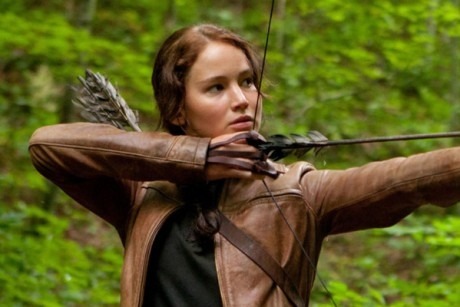
I feel like I should apologize for using this picture because JLaw trained with a hardcore Olympic archer and has pretty damn good form and is really mid-draw here, but it was the best one I could find to illustrate an underdrawn position. (Everything else is good, though.) Again, this is if you're not pulling the bowstring back all the way until it touches your face. A lot of people will get about this far back and then just release without anchoring, or draw back and release while still drawing. Particularly with low-poundage beginner bows, the end result is the arrow sort of launching in a weak arc and flopping sadly to the ground short of the target, or flying high.
- Overdrawing.

OLIVER QUEEN, NO. JUST NO. This isn't just an issue of overdraw, actually, but the bowstring is definitely in an overdraw position in most forms of archery. Kyudo is a notable exception due to the sheer height of the bow. If you're pulling the bowstring back that far you're doing something wrong. Actually, the issue with Stephen Amell's form above is that he's not fully extended; his bow arm is bent, so he's pulling well past his anchor point to try and get to full draw. (I have totally become Buffy Summers critiquing action flicks because these pictures actively pain me. What even is my life now I don't understand.)
Other risks of overdrawing: Pull the arrow back far enough to slide it off the arrow rest, and you run the risk of shooting it into the riser of your bow, causing the arrow to break or possibly shatter. Or, more likely, shooting yourself in the hand. This is actually the reason most beginning archery students get arrows that are a couple of inches longer than their draw length, to reduce the chance of that happening. (Draw length varies per person, of course, what with varying arm lengths and body proportions. It won't hurt to have arrows that are a couple of inches too long, but any more than that and they won't balance properly. The general concept is that your arrows should be just long enough that when you're at full draw, there shouldn't be more than just the tip protruding past the edge of the riser for maximum balance/stable flight. You definitely don't want arrows that are too short, though, because that way lies badness.)
Inconsistent Release
- This one is a major pain in the ass. It's still my major source of grief. The general idea is that when you release the string you're simply relaxing your fingers and sliding your hand straight back as followthrough. (This is another reason for the anchor point.) This is in no way as simple as it sounds. You also don't want to just open your hand and let go. Because you actually can't just do that with 12 or more pounds of bowstring tension against your fingers.
- Plucking the string is the biggest release issue. Basically, instead of just letting the string go so it snaps back naturally in the direction it came from, you're plucking it to one side or the other, which will send your arrow off to the side.
- Moving your head to watch your shot after you release. That tweaks the position of your bow arm and your followthrough, and throws your shot off. You don't want to move basically at all until the arrow is completely clear of the bow.
- (I just learned this!) Followthrough should be identical on every shot. Your hand should remain in contact with your face, and your followthrough should stop at the same point every time. (You'll have to make note of this and recognize it by touch, i.e. you can feel your knuckles against your earlobe. The actual point can vary, just make sure you can recognize it.)
- That way you'll be able to recognize by feel if you're doing something wrong on your followthrough.
- Letting the bow arm drop as soon as you release the arrow. This will also tweak your followthrough and make your shot go low/possibly off to the side.
- Ideal arrow flight should be stable and in a straight line, no wobbling. Excess arrow movement in flight is wasted kinetic energy and weakens the impact of the shot.
Too much tension in the bow arm
- Gripping the riser of the bow too tightly. You don't actually want or need to have a chokehold on the bow riser; you actually want to just let it rest on your hand, make a loose circle with your thumb and index finger, and relax the rest of your fingers. This makes a lot of people nervous about dropping the bow, so they tend to grip with all their fingers anyway. It does have a tendency to "jump" forward out of the hand on release, so the reaction's understandable.
- Tensing up/raising the shoulder of your bow arm. I had a really bad habit of tensing and raising my shoulder that got me yelled at a lot when I started, because it's not only terrible form, but it will damage your shoulder if you keep doing it.
- Basically, either one of these things is going to mess up your shot.
Nocking the Arrow Improperly
- Every bowstring has a nock point attached to it: usually a small brass ring crimped around the string, or thread knotted around the servings, which counteracts the arrow's natural tendency to move upward. The arrow should always be nocked below and flush to the nock point. Nocking above the point will make your shot go all over the place. Nocking too low will make your arrows "porpoise," or wobble vertically. (That's also the case if the nock point of your bow is set too low to begin with.)
- Arrows typically have two feathers or vanes of one color, and a third of a different color. That's your index or cock (yeah, yeah, we know) feather, and it should always be facing outward, away from the bow riser. Turn it inward and the arrow won't get proper clearance, which means the fletching will rub against the riser on release (it's always going to sound dirty so just get used to it) and mess up your shot. Or possibly rip your fletching off. Probably both, definitely the first.
Drawing too heavy a bow
- It's very tempting to go for the bow with the heaviest poundage you can pull, even if you're shaking with the effort of holding it at full draw, right? You don't want to do that. For one, longbows and recurve bows are easy to draw initially, but the longer you have to hold them at full draw (to aim, make sure you're properly anchored, etc.) the harder it is. And you can't concentrate on getting your form correct if you have to concentrate on just keeping your bow at draw.
Dropping the elbow of your shooting arm
- At draw, your elbow should be pointing straight back, in line with your bow arm. (This takes a little work from your deltoids, since you have to squeeze your shoulder blades together to get your arm in line.) It should also be just slightly above level. You don't want it to be below the level of your shoulder.
Grouping vs. Placement

(Yeah, okay, so that's one of mine. I was really proud of that one. Except for that one that went high, UGH.)
- Everybody gets excited the first time they get a bullseye. However, if you focus on trying to do that you're going to develop a lot of bad habits starting out. One hit on target doesn't honestly mean much if your other arrows are all over the place.
- When you're learning, grouping is much more important than placement. You can't reliably adjust your aim if you can't consistently get your shots in the same place, because there are too many variables in your shooting technique to pinpoint exactly what's wrong. Once again, this all comes down to form. It always comes down to form. Otherwise you're focusing on making all these adjustments, overcompensating, and not concentrating on doing the exact same thing every shot.
- Once you can consistently get all your shots within about a four-inch radius of each other somewhere on the target face, then you can start worrying about fine-tuning your aim.
Mental Focus
- Archery's as much mental as it is physical. You can't be distracted while shooting because of all those five million tiny details that you have to concentrate on getting right every time. One of the archers at my range once told me that you should never shoot on an empty stomach because whether you like it or not you're going to start thinking about food and it'll distract you. I tested that theory. He was right.
- So, actually, concentrating and clearing your mind should be a part of your process on every shot. Get your arrow nocked and your fingers set on the string first. Then clear your head, set your stance, breathe, turn and sight on the target, draw, aim, release. Same process every time.
Non Form-Related Things
- Loose-fitting clothing. Sleeves that are too loose or bulky (like a sweatshirt) can snag on your bowstring and mess up your shot.
- Not using safety gear. Armguards and finger tabs/shooting gloves are a must, because you'll probably hit your arm with the bowstring a lot when you're starting out and believe me, that bruises like a mofo, and you will permanently damage the nerve endings in your fingertips if you don't have the fingers of your shooting hand protected. (I shoot a 26 pound bow, which is comparatively not all that heavy, and after two hours using a finger tab that was too small and not covering everything it should, I couldn't feel my fingertips for hours, and there were blood blisters. It's not pretty. Seriously, use your safety gear.)
- Nocking an arrow is sometimes much harder than it looks, because you're holding the bow in one hand and have either a finger tab or a shooting glove on the other, messing with your manual dexterity. It's really common for beginning archers to drop an arrow in the process of nocking it. (Stepping past the shooting line to retrieve it if there are other people on the line and shooting is a HUGE safety faux pas. You do not do it.)
- Sometimes keeping an arrow on the arrow rest while you draw can be tricky; if you're pinching your fingers down around the arrow nock and your arrow rest isn't the kind that curves up to hold the shaft in place, it can sometimes swing out away from the bow, and then you have to stop drawing, reset, and start over again. And possibly mess up your shot because you're fretting about making sure you don't do that on the second attempt.
- Shooting across lanes. It's A) rude as hell, and B) a safety issue. You don't try to shoot a target to the right of the archer standing on your right, or vice versa. Arrows are expensive, and nobody will be happy with you if you damage their arrows by shooting diagonally across other people's shot trajectories.
Okay. All of this is with the caveat that there are different shooting techniques depending on whether you're target shooting or hunting, and some variation depending on the type of bow you're using, but the basics of form are pretty much the same.
Also I apologize for picking on fictional archers with my illustrations here but honestly it's the easiest way to find pictures of bad form. -_- In part because sometimes it just looks better on camera, admittedly.
Basic Range Safety
- Do not nock, much less shoot, an arrow while standing anywhere but on the shooting line. Huge no.
- Do not cross the shooting line to retrieve arrows until all archers are done shooting. If it appears all archers are done shooting, yell "clear." Wait until other archers confirm by responding "clear," then proceed to the targets to retrieve arrows.
- Bows should remain on the bow rack when walking downrange. You'll need both hands anyway.
- Do not run when walking downrange to retrieve arrows.
- Do not nock, much less shoot, an arrow while anyone is down range. Absolutely not. No. You do not step past the shooting line before the range is signaled clear, and you do not so much as take an arrow out of your quiver until everyone has retrieved their arrows and is back behind the line.
- NEVER DRY-FIRE THE BOW. Holy crap, I cannot stress this enough. This is drawing the bowstring and releasing without an arrow nocked properly. This is Very Bad. The ONLY time a bow should ever be drawn and released is if there is an arrow on the string; otherwise, the kinetic energy from the release, without an arrow to transfer to, will kick back into the bow limbs and damage them. Do it with a high poundage bow and it'll break. You can draw the bow without an arrow, just to practice/work on form, but always make sure you keep hold of the string and ease it back slowly.
(Standard indoor/short range distance is 18 meters or 20 yards. Target butts can be set up at closer distances for people who can't manage to shoot that far yet because they're pulling a very light bow/just having trouble. Outdoor/long range distances can be set up anywhere from 9 to 70 yards.)
Basic Archery Form, And Common Mistakes People Make With It
Stance
- Proper stance entails standing at right angles to the target, bow arm up front. (Facing to the right if you're a right handed shot -- bow in left hand, drawing with right hand -- and to the left if you're a left handed shot.) If you're trying to face forward, you're not going to get anywhere near the right kind of extension to draw the bow. You'd be surprised how many people actually try to do this.
Wrong eye.
- Determining whether you're a right or left handed shot has nothing to do with your dominant hand. It's all about your dominant eye, because that's the one you'll be using to sight with and should be the one closer to the bowstring. A lot of people tend to go for the bow that goes into their non-dominant hand regardless of eye dominance. It's more of an adjustment if your dominant eye and hand don't match up, but your aim will be better once you get used to it.
Improper Bow Arm Extension
- Armguards are there to protect you from bruising if you smack yourself in the arm with your bowstring on release, but generally speaking, if your string keeps hitting your arm it means your form is off. Among females especially (it's an anatomy thing) there's a tendency to hyperextend the elbow a bit, pushing it in toward the bowstring. The arm should actually be rotated so the elbow is pointing outward and the palm of the hand is pointing down (see below for example).
Inconsistent Draw
- In archery, proper form is everything. Shot accuracy depends on you being able to duplicate the exact same movements down to the minutest detail every single time. One of the most basic parts of proper form is having an anchor point, typically the side of the face (more traditional/longbow style), or just under the jaw, where your hand comes into contact with your face. Every time you draw your bowstring, you want to draw it to the exact same point: you should feel the back of your thumb in contact with your anchor point, and the string should be touching the tip of your nose and the corner of your mouth. This ensures that you are A) getting a consistent draw length, B) drawing the bow at the same (correct) angle, and C) in proper head/arm/stance alignment.
If you're not anchoring, or your anchor point keeps moving, your shots will be all over the place and rarely close to where you want them.
- Underdrawing.
I feel like I should apologize for using this picture because JLaw trained with a hardcore Olympic archer and has pretty damn good form and is really mid-draw here, but it was the best one I could find to illustrate an underdrawn position. (Everything else is good, though.) Again, this is if you're not pulling the bowstring back all the way until it touches your face. A lot of people will get about this far back and then just release without anchoring, or draw back and release while still drawing. Particularly with low-poundage beginner bows, the end result is the arrow sort of launching in a weak arc and flopping sadly to the ground short of the target, or flying high.
- Overdrawing.
OLIVER QUEEN, NO. JUST NO. This isn't just an issue of overdraw, actually, but the bowstring is definitely in an overdraw position in most forms of archery. Kyudo is a notable exception due to the sheer height of the bow. If you're pulling the bowstring back that far you're doing something wrong. Actually, the issue with Stephen Amell's form above is that he's not fully extended; his bow arm is bent, so he's pulling well past his anchor point to try and get to full draw. (I have totally become Buffy Summers critiquing action flicks because these pictures actively pain me. What even is my life now I don't understand.)
Other risks of overdrawing: Pull the arrow back far enough to slide it off the arrow rest, and you run the risk of shooting it into the riser of your bow, causing the arrow to break or possibly shatter. Or, more likely, shooting yourself in the hand. This is actually the reason most beginning archery students get arrows that are a couple of inches longer than their draw length, to reduce the chance of that happening. (Draw length varies per person, of course, what with varying arm lengths and body proportions. It won't hurt to have arrows that are a couple of inches too long, but any more than that and they won't balance properly. The general concept is that your arrows should be just long enough that when you're at full draw, there shouldn't be more than just the tip protruding past the edge of the riser for maximum balance/stable flight. You definitely don't want arrows that are too short, though, because that way lies badness.)
Inconsistent Release
- This one is a major pain in the ass. It's still my major source of grief. The general idea is that when you release the string you're simply relaxing your fingers and sliding your hand straight back as followthrough. (This is another reason for the anchor point.) This is in no way as simple as it sounds. You also don't want to just open your hand and let go. Because you actually can't just do that with 12 or more pounds of bowstring tension against your fingers.
- Plucking the string is the biggest release issue. Basically, instead of just letting the string go so it snaps back naturally in the direction it came from, you're plucking it to one side or the other, which will send your arrow off to the side.
- Moving your head to watch your shot after you release. That tweaks the position of your bow arm and your followthrough, and throws your shot off. You don't want to move basically at all until the arrow is completely clear of the bow.
- (I just learned this!) Followthrough should be identical on every shot. Your hand should remain in contact with your face, and your followthrough should stop at the same point every time. (You'll have to make note of this and recognize it by touch, i.e. you can feel your knuckles against your earlobe. The actual point can vary, just make sure you can recognize it.)
- That way you'll be able to recognize by feel if you're doing something wrong on your followthrough.
- Letting the bow arm drop as soon as you release the arrow. This will also tweak your followthrough and make your shot go low/possibly off to the side.
- Ideal arrow flight should be stable and in a straight line, no wobbling. Excess arrow movement in flight is wasted kinetic energy and weakens the impact of the shot.
Too much tension in the bow arm
- Gripping the riser of the bow too tightly. You don't actually want or need to have a chokehold on the bow riser; you actually want to just let it rest on your hand, make a loose circle with your thumb and index finger, and relax the rest of your fingers. This makes a lot of people nervous about dropping the bow, so they tend to grip with all their fingers anyway. It does have a tendency to "jump" forward out of the hand on release, so the reaction's understandable.
- Tensing up/raising the shoulder of your bow arm. I had a really bad habit of tensing and raising my shoulder that got me yelled at a lot when I started, because it's not only terrible form, but it will damage your shoulder if you keep doing it.
- Basically, either one of these things is going to mess up your shot.
Nocking the Arrow Improperly
- Every bowstring has a nock point attached to it: usually a small brass ring crimped around the string, or thread knotted around the servings, which counteracts the arrow's natural tendency to move upward. The arrow should always be nocked below and flush to the nock point. Nocking above the point will make your shot go all over the place. Nocking too low will make your arrows "porpoise," or wobble vertically. (That's also the case if the nock point of your bow is set too low to begin with.)
- Arrows typically have two feathers or vanes of one color, and a third of a different color. That's your index or cock (yeah, yeah, we know) feather, and it should always be facing outward, away from the bow riser. Turn it inward and the arrow won't get proper clearance, which means the fletching will rub against the riser on release (it's always going to sound dirty so just get used to it) and mess up your shot. Or possibly rip your fletching off. Probably both, definitely the first.
Drawing too heavy a bow
- It's very tempting to go for the bow with the heaviest poundage you can pull, even if you're shaking with the effort of holding it at full draw, right? You don't want to do that. For one, longbows and recurve bows are easy to draw initially, but the longer you have to hold them at full draw (to aim, make sure you're properly anchored, etc.) the harder it is. And you can't concentrate on getting your form correct if you have to concentrate on just keeping your bow at draw.
Dropping the elbow of your shooting arm
- At draw, your elbow should be pointing straight back, in line with your bow arm. (This takes a little work from your deltoids, since you have to squeeze your shoulder blades together to get your arm in line.) It should also be just slightly above level. You don't want it to be below the level of your shoulder.
Grouping vs. Placement
(Yeah, okay, so that's one of mine. I was really proud of that one. Except for that one that went high, UGH.)
- Everybody gets excited the first time they get a bullseye. However, if you focus on trying to do that you're going to develop a lot of bad habits starting out. One hit on target doesn't honestly mean much if your other arrows are all over the place.
- When you're learning, grouping is much more important than placement. You can't reliably adjust your aim if you can't consistently get your shots in the same place, because there are too many variables in your shooting technique to pinpoint exactly what's wrong. Once again, this all comes down to form. It always comes down to form. Otherwise you're focusing on making all these adjustments, overcompensating, and not concentrating on doing the exact same thing every shot.
- Once you can consistently get all your shots within about a four-inch radius of each other somewhere on the target face, then you can start worrying about fine-tuning your aim.
Mental Focus
- Archery's as much mental as it is physical. You can't be distracted while shooting because of all those five million tiny details that you have to concentrate on getting right every time. One of the archers at my range once told me that you should never shoot on an empty stomach because whether you like it or not you're going to start thinking about food and it'll distract you. I tested that theory. He was right.
- So, actually, concentrating and clearing your mind should be a part of your process on every shot. Get your arrow nocked and your fingers set on the string first. Then clear your head, set your stance, breathe, turn and sight on the target, draw, aim, release. Same process every time.
Non Form-Related Things
- Loose-fitting clothing. Sleeves that are too loose or bulky (like a sweatshirt) can snag on your bowstring and mess up your shot.
- Not using safety gear. Armguards and finger tabs/shooting gloves are a must, because you'll probably hit your arm with the bowstring a lot when you're starting out and believe me, that bruises like a mofo, and you will permanently damage the nerve endings in your fingertips if you don't have the fingers of your shooting hand protected. (I shoot a 26 pound bow, which is comparatively not all that heavy, and after two hours using a finger tab that was too small and not covering everything it should, I couldn't feel my fingertips for hours, and there were blood blisters. It's not pretty. Seriously, use your safety gear.)
- Nocking an arrow is sometimes much harder than it looks, because you're holding the bow in one hand and have either a finger tab or a shooting glove on the other, messing with your manual dexterity. It's really common for beginning archers to drop an arrow in the process of nocking it. (Stepping past the shooting line to retrieve it if there are other people on the line and shooting is a HUGE safety faux pas. You do not do it.)
- Sometimes keeping an arrow on the arrow rest while you draw can be tricky; if you're pinching your fingers down around the arrow nock and your arrow rest isn't the kind that curves up to hold the shaft in place, it can sometimes swing out away from the bow, and then you have to stop drawing, reset, and start over again. And possibly mess up your shot because you're fretting about making sure you don't do that on the second attempt.
- Shooting across lanes. It's A) rude as hell, and B) a safety issue. You don't try to shoot a target to the right of the archer standing on your right, or vice versa. Arrows are expensive, and nobody will be happy with you if you damage their arrows by shooting diagonally across other people's shot trajectories.
![[identity profile]](https://www.dreamwidth.org/img/silk/identity/openid.png)


no subject
Date: 2013-05-24 12:44 pm (UTC)no subject
Date: 2013-05-24 01:39 pm (UTC)no subject
Date: 2013-05-24 02:56 pm (UTC)Re: non-form related things:
-That's why it was actually easier to shoot in a dress with no sleeves than a hoodie with sleeves catching on the string
-Or the arrow keeps sliding off because you're me and haven't noticed that your arrow rest has completely worn down
-If you shoot 12 arrows across two lanes at someone else's Star Wars card, I reserve the right to smack you.
no subject
Date: 2013-05-24 04:41 pm (UTC)Also I'm not smacking you while you're on the shooting line, but I'll try and point it out to you if, you know, I'm not on the line too. I actually got a tip about using your anchor point as a pivot to keep your arm aligned, but it's hard to explain. I might just have to show you.
no subject
Date: 2013-05-24 05:13 pm (UTC)And when I get back next week?
no subject
Date: 2013-05-24 05:15 pm (UTC)WHAT DO YOU MEAN, YOU WON'T BE THERE TOMORROW? SCANDAL OMG. ;)
no subject
Date: 2013-05-24 05:26 pm (UTC)Oh! It's also a very bad idea to have loose jewelry on your wrists. Because then your watch gets tangled in your shooting glove and you nearly dislocate your wrist. Not that I'm speaking from experience or anything.
no subject
Date: 2013-05-24 05:29 pm (UTC)no subject
Date: 2013-05-24 05:36 pm (UTC)